


This is the prototype for our new-and-experimental Short variety
of article. If well-received, these Shorts will help to fill the gaps
between full articles. Please let us know what you think…who likes short
Shorts?
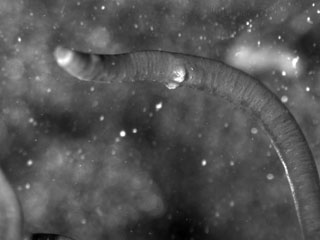 In
1887, a glacial geologist named George Frederick Wright was hiking
across the Muir Glacier in southeast Alaska when something strange
caught his eye. Just as the daylight began to fade, the previously
uninterrupted expanse of white snow around him began to develop what
appeared to be a five o’clock shadow. These wriggling “whiskers” grew
rapidly and emerged from the solid ice, leaving the snow crawling with
an astonishing number of small black worms. Within approximately an hour
there were tens of thousands of them criss-crossing the snow as far as
he could see, leaving nary a square inch unwormed. A few hours later
they began to slip effortlessly back into the ice, ultimately leaving
nothing but pure white snow behind for the morning sun. The ice
scientist brought news of these strange ice worms back to polite civilization, yet even over a century later little is known about the intriguing organisms.
In
1887, a glacial geologist named George Frederick Wright was hiking
across the Muir Glacier in southeast Alaska when something strange
caught his eye. Just as the daylight began to fade, the previously
uninterrupted expanse of white snow around him began to develop what
appeared to be a five o’clock shadow. These wriggling “whiskers” grew
rapidly and emerged from the solid ice, leaving the snow crawling with
an astonishing number of small black worms. Within approximately an hour
there were tens of thousands of them criss-crossing the snow as far as
he could see, leaving nary a square inch unwormed. A few hours later
they began to slip effortlessly back into the ice, ultimately leaving
nothing but pure white snow behind for the morning sun. The ice
scientist brought news of these strange ice worms back to polite civilization, yet even over a century later little is known about the intriguing organisms.The creatures that Wright observed were Mesenchytraeus solifugus–inch-or-so long ice-dwelling worms that reside exclusively in the coastal glaciers of Alaska, British Columbia, Washington, and Oregon. The ice worms are so married to their home glaciers that even when a glacier is surrounded by a snow field the creatures will not wander more than a few meters from the underlying glacier’s edge. Moreover, these unusual organisms thrive only at temperatures near the freezing point of water. If one warms an ice worm to even a few degrees above freezing the worm will melt into goo. During the coldest months of the year the worms do not appear on the surface at all; it is suspected that they creep deep into the ice and suspend their animations for the duration of winter.
Although the ice worms lack eyes, some unknown mechanism allows them
to respond to light and dark. By day the throngs of worms lurk as deep
as two meters below the surface, and by night they squirm out to feed.
Their preferred foods are bacteria, bits of pollen, and various snow
algae including watermelon snow, a pinkish algae which creates
swaths of snow that have the hue and aroma of fresh watermelon. Exactly
how these worms penetrate the seemingly solid glacier ice is still a
mystery. Some researchers hypothesize that the worms use the large pore
atop their heads to excrete a lubricant that allows them to slip through
minuscule fissures, while others suggest that the same pore might
instead secrete an antifreeze agent that melts a path through the ice.
Although ice worms are usually solitary wanderers in the friscalating
dusklight, they do occasionally linger in meltwater pools during the
day. There they often intermingle as writhing, knotty groups engaged in
what is assumed to be reproductive ice worm orgies.
In recent years NASA has provided limited funding to reverse-engineer Mesenchytraeus solifugus‘
cold tolerance to see if it might provide insight into possible life on
our icy neighboring planets. More pragmatic scientists are also teasing
out the ice worms’ secrets in hopes that the cold-resistant proteins
might enable long-term cold-storage of human organ and tissues for
transplantation. Sadly, our opportunity to exploit the ice worms is
shrinking just as rapidly as the glaciers that they inhabit. Sorry ice
worms. With warmest personal regards, humanity.


0 comments:
Post a Comment