But a billion years of bacterial evolutionary progress was soon
stunted by a catastrophic global event. Geologists find no signs of a
great meteor impact nor a volcanic eruption, but they have uncovered the
unmistakable geologic scars of rapid worldwide climate change. Average
temperatures, which were previously comparable to our present climate,
plummeted to minus 50 degrees Celsius and brought the planet into its
first major ice age. This environmental shift triggered a massive
die-off which threatened to extinguish all life on Earth, and
paleoclimatologists have good reason to believe that this world-changing
event was unwittingly caused by some of the planet’s own humble
residents: bacteria.
The period in history is known as the
Paleoproterozoic era, and
prior to that time the Earth’s ecology and environment were
significantly different. The iron-rich waters of the oceans lent them a
green tint, and the atmosphere was comprised of gasses other than
oxygen. Although oxygen atoms were abundant, such as those found in
water molecules, unbound oxygen was extremely rare. The sea was host to a
plethora of anaerobic microorganisms, but there were also a few members
of a newly evolved variety: a blue-green algae known as
cyanobacteria.
These adapted bacteria were the first to use water and sunlight for
photosynthesis, producing oxygen as a by-product of their metabolism.

The cyanobacteria were a struggling minority at first, but scientists
believe that these new microbes began to dominate with the help of
meltwater from a few glaciers scattered across the young continents.
These glaciers spent centuries scraping across the Earth collecting
minerals, ultimately depositing their rich nutrient payloads into the
oceans. The cyanobacteria flourished in the presence of the increased
minerals, and the rapidly growing population was soon venting
increasingly large amounts of its poisonous waste oxygen into the
environment.
At first the damage was limited to the oceans’ ecosystems. The
underwater oxygen began to chemically react with the abundant iron,
eventually scrubbing the seas clean of the element through oxidation.
The oxidized iron settled to the ocean floor, and the oceans’ green tint
began to fade. This series of developments was nothing short of an
ecological disaster– oxygen was poisonous to most of primitive Earth’s
inhabitants, and many bacteria relied on the iron as a nutrient.
Once
the oceans’ supply of iron was exhausted, oxygen began to seep from the
sea into the air. With very little competition for resources,
cyanobacteria continued to proliferate and pollute. The free oxygen they
produced reacted with the air, gradually breaking down the methane
which kept the Earth’s atmosphere warm and accommodating. It took at
least a hundred thousand years– a short duration in geological terms–
but the Earth was eventually stripped of her methane, and with it her
ability to store the heat from the sun. Temperatures fell well below
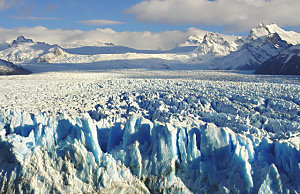
freezing worldwide, and a thick layer of ice began to encase the
oxygen-saturated planet.
Not even cyanobacteria were immune to the effects of this major ice
age. The traits which had once given them such an evolutionary advantage
were creating an environment which was completely inhospitable, even
for themselves. As the centuries marched on, the surface became
increasingly cold and frozen, with the ice at the equator eventually
reaching up to one mile in thickness: Earth was an ice planet. Thermal
vents on the ocean floor provided pockets where some resilient bacteria
managed to survive, and certain organisms which lived underground were
insulated from much of the destruction; but these reservoirs of life
were scarce. Almost every living thing on Earth died as a result of this
massive bacteria-induced climate change, an event known as the
oxygen catastrophe.
As told by the Earth’s ancient rocks, the story of the
Paleoproterozoic era is one of near-extinction for all life on the
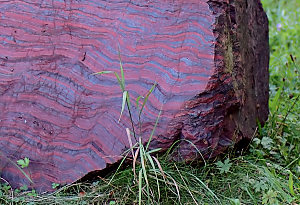
planet. The rocks that lined the ocean floor during that period are
layered with oxidized iron… the remains of the iron that was removed by
the oxygen. Layers from previous periods have no such banded iron
formations. The fossilized microbes in the rocks are also indicative of
violent climate change.
The survivors of the oxygen catastrophe eventually adapted to consume
the abundant oxygen and produce carbon dioxide. This greenhouse gas
very gradually made its way into the atmosphere, increasing in
concentration and nudging temperatures back into the hospitable range
over millions of years. Had temperatures been slightly colder during the
first major ice age– if Earth had been in a slightly more distant
orbit– the planet would have remained an icy wasteland because the
carbon dioxide would have frozen solid before it could promote the
greenhouse effect.
Banded iron formation, caused by layers of oxidized iron
Temperatures reached as low as minus 50 degrees Celsius, and carbon
dioxide freezes into dry ice at minus 78 degrees. Indeed it seems that
life on Earth was spared by a very tiny margin.

Today all life on the planet can trace its lineage back to those few
microorganisms which survived the great dying of 2,500,000,000 BC, and
now cyanobacteria are among the most common bacteria on Earth. In the
billions of years since the first ice age, the environment has been
dramatically altered on numerous occasions by greenhouse gases which
trap heat; by shifting tectonic plates which reroute ocean currents; by
our sun’s varying radiation levels; and by volcanic activity which
alters the atmosphere. But at least once in Earth’s long history, its
own occupants seem to have unwittingly brought all life to the brink of
extinction. The sun is warmer now than it was then, so such a “Snowball
Earth” is a bit less likely to occur… but the cautionary tale catalogued
in ancient rocks warns us that the environment is certainly not
impervious to the actions of those living in it.